
Understanding the Impact of Water Absorption
in Insulating Composites
The Gund Company fabricates electrical insulation components for power systems equipment, including generators, transformers, switchgear, power supplies, electric motors, and related equipment.
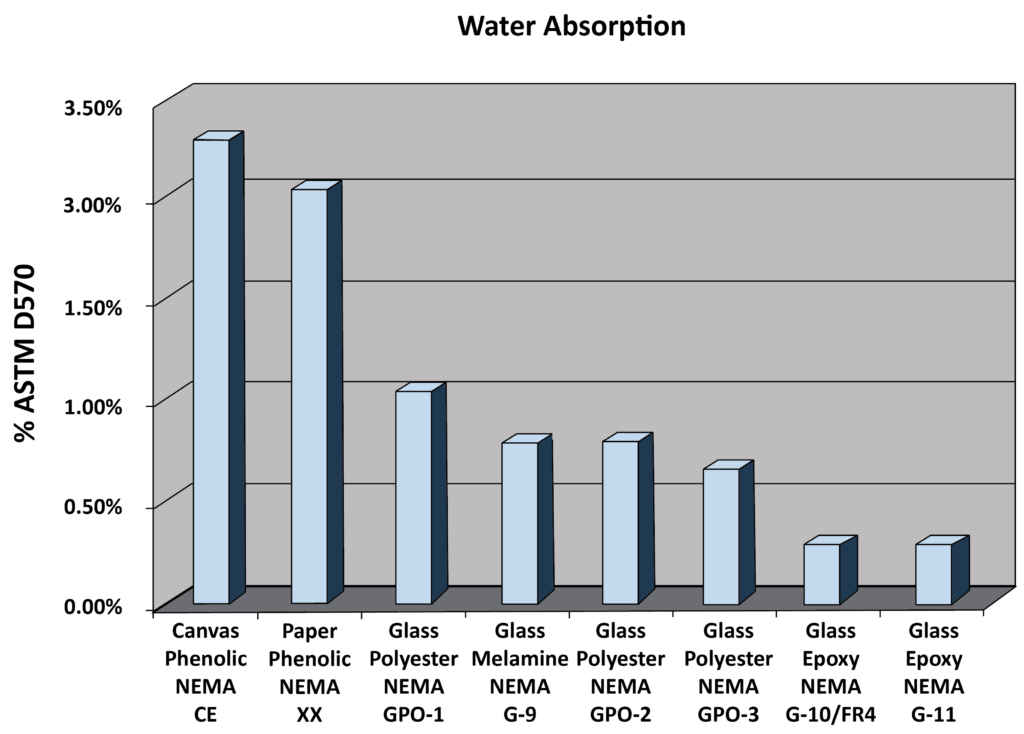
Particularly in composites, selecting insulating materials can be quite a challenge due to the number of factors that influence insulation system engineering and insulation component design. One significant variable to consider is the material’s water or moisture absorption.
Water absorption significantly reduces the performance and durability of composite materials. When moisture penetrates the polymer matrix and fibers, it alters the internal structure, weakening mechanical properties, reducing insulating effectiveness, and leading to poor reliability in demanding environments.
Mechanical Properties – The material’s tensile and flexural properties decline as water molecules disrupt the bond between fibers and the surrounding resin matrix. This debonding reduces the efficiency of stress transfer, making composites more prone to cracking and failure under load.
Electrical Properties – Water absorption reduces the electrical insulating properties of composites by increasing conductivity, raising dielectric losses, and lowering breakdown strength. In short, moisture compromises their ability to act as reliable electrical insulators.
Dimensional stability – Water diffuses into the polymer matrix, causing microcracking. This leads to swelling, warping, and loss of dimensional accuracy.
Long-term performance – Moisture exposure increases crack growth rates and reduces the service life of composites. Over time, repeated wet–dry cycles exacerbate microstructural damage, making materials brittle and less reliable. Composites exposed to humid or submerged environments face significant performance degradation.
The water or moisture absorption of a material is a key property that is often overlooked. According to ASTM D570, the American Standard Test Method for determining the Water Absorption of Plastics, “the moisture content of a plastic or composite is very intimately related to such properties as electrical insulation resistance, dielectric losses, mechanical strength, appearance, and dimensions.” Of course, with insulation materials, the absorption of water from high-humidity conditions can result in the originally designed insulator becoming a conductor.
Ready to dive deeper?
Get the full white paper and explore insulation materials tailored to your application.
Choose an option below to gain access to our technical library or connect with a material expert today!