
Explaining the Differences Between
SMC and BMC Molding
Composite molding compounds have revolutionized industries such as automotive, aerospace, power distribution, and oil and gas. Among them, Sheet Molding Compound (SMC) and Bulk Molding Compound (BMC) are widely used for their high strength, light weight, durability, corrosion resistance, and versatility. While they are both reinforced and use similar resin systems, their differences in composition and processing make them suitable for distinct applications.
Composition
Sheet Molding Compound (SMC) is a ready-to-mold composite material primarily composed of a thermosetting resin matrix reinforced with chopped glass fibers. Chopped glass fibers, usually around 1 inch (25 mm) in length, are uniformly dispersed throughout the base resin—typically unsaturated polyester, vinyl ester, or epoxy—to provide structural reinforcement. Fillers can be added to enhance mechanical or flame resistance, reduce cost, and improve surface finish. The mixture is processed into a sheet form and allowed to mature until it reaches a moldable consistency. This sheet format allows for easy handling and consistent distribution during compression molding, making SMC ideal for producing large, high-strength components with excellent dimensional stability and surface quality.
Bulk Molding Compound (BMC) is a thermoset composite material formulated for high-volume molding applications. Like SMC, BMC typically consists of an unsaturated polyester, epoxy, or vinyl ester base resin, combined with short-chopped glass fibers (usually less than 0.25 inches in length) that provide mechanical reinforcement. Fillers can also be added to enhance dimensional stability, flame resistance, reduce cost, and modify color. Unlike SMC, the resulting compound has a dough-like consistency, making it easy to handle and suitable for compression, injection, or transfer molding. BMC’s uniform dispersion of fibers and additives ensures consistent performance, making it ideal for producing small, intricate components with excellent electrical insulation, thermal resistance, and surface finish.
| Property | SMC | BMC |
|---|---|---|
| Fiber length | Longer (~1 inch) | Shorter (<0.25 inch) |
| Strength | Higher mechanical strength | Moderate strength |
| Surface Finish | Superior, smooth | Good but less refined |
| Dimensional Stability | Excellent | Excellent |
| Electrical Insulation | Good | Excellent (widely used in electrical parts) |
Processing Methods
The processing of SMC is primarily carried out through compression molding, a technique well-suited for producing large, strong, and dimensionally stable components. In this process, the SMC sheet material is first cut into charges of appropriate size and shape. These charges are then placed into a heated mold cavity, where carrier films are removed, and the compound is arranged to cover the mold surface evenly. Once the mold is closed, high pressure and heat are applied, causing the resin to flow, fill the cavity, and cure into the desired shape. The curing reaction crosslinks the thermosetting resin, permanently hardening the part. This method is widely used in automotive body panels, electrical enclosures, and other structural applications where durability and precision are critical.
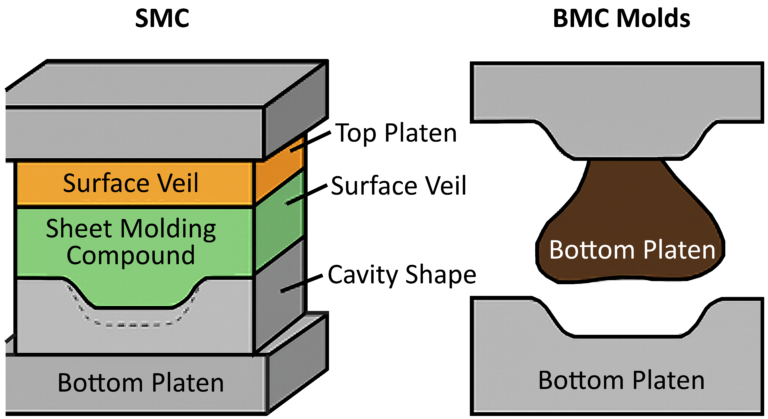
BMC can be processed using several molding techniques, with compression molding and injection molding being the most common. In compression molding, a measured charge of BMC paste is placed directly into a heated mold cavity, and pressure is applied until the resin flows, fills the cavity, and cures into the final part. Injection molding of BMC involves feeding the compound into a heated barrel and injecting it into the mold under pressure, which is particularly effective for producing small, intricate, and high-volume components. Across both methods, the curing process crosslinks the thermosetting resin, permanently hardening the part. These processing techniques make BMC highly versatile, enabling the production of complex shapes with excellent dimensional stability, electrical insulation, and resistance to heat and chemicals.
Conclusion
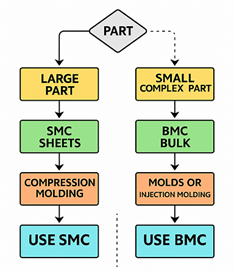
While both SMC and BMC are molded thermoset composites, their differences in fiber length, material form, and processing methods make them complementary rather than interchangeable. SMC excels in strength and surface finish for large parts, whereas BMC is optimized for small, complex, and electrically insulating components. Choosing between them depends on the size, strength requirements, and functional application of the molded product.
| Material | Applications |
|---|---|
| SMC (Sheet Molding Compound) |
– Automotive body panels, hoods, and exterior parts – Large enclosures and structural components – Aerospace and industrial equipment requiring high strength |
| BMC (Bulk Molding Compound) |
– Electrical housings, circuit breaker components, and connectors – Appliance parts (handles, knobs, pump housings) – Small automotive and industrial components |
To read the full article and gain access to our other technical white papers, click here!